

02Particle content
The Standard Model includes members of several classes of elementary particles, which in turn can be distinguished by other characteristics, such as color charge.
All particles can be summarized as follows:
| Elementary particles | |||||||||||||||||||||||||||||
| Elementary fermionsHalf-integer spinObey the Fermi-Dirac statistics | Elementary bosonsInteger spinObey the Bose-Einstein statistics | ||||||||||||||||||||||||||||
| Quarks and antiquarksSpin = 1/2Fractional electric chargeHave color chargeParticipate in both strong interactions and in electroweak interactions | Leptons and antileptonsSpin = 1/2Integer electric chargeNo color chargeParticipate in Electroweak interactions | Gauge bosonsSpin = 1Force carriers | Scalar bosonsSpin = 0 | ||||||||||||||||||||||||||
| Three generations | Three generations
| Three kinds
| One kind Higgs boson (H0 ) | ||||||||||||||||||||||||||
Notes:
[†] An anti-electron (e+
) is conventionally called a "positron".
Fermions
The Standard Model includes 12 elementary particles of spin 1/2, known as fermions. Fermions respect the Pauli exclusion principle, meaning that two identical fermions cannot simultaneously occupy the same quantum state in the same atom. Each fermion has a corresponding antiparticle, which are particles that have corresponding properties with the exception of opposite charges. Fermions are classified based on how they interact, which is determined by the charges they carry, into two groups: quarks and leptons. Within each group, pairs of particles that exhibit similar physical behaviors are then grouped into generations (see the table). Each member of a generation has a greater mass than the corresponding particle of generations prior. Thus, there are three generations of quarks and leptons. As first-generation particles do not decay, they comprise all of ordinary (baryonic) matter. Specifically, all atoms consist of electrons orbiting around the atomic nucleus, ultimately constituted of up and down quarks. On the other hand, second- and third-generation charged particles decay with very short half-lives and can only be observed in high-energy environments. Neutrinos of all generations also do not decay, and pervade the universe, but rarely interact with baryonic matter.
There are six quarks: up, down, charm, strange, top, and bottom. Quarks carry color charge, and hence interact via the strong interaction. The color confinement phenomenon results in quarks being strongly bound together such that they form color-neutral composite particles called hadrons; quarks cannot individually exist and must always bind with other quarks. Hadrons can contain either a quark-antiquark pair (mesons) or three quarks (baryons). The lightest baryons are the nucleons: the proton and neutron. Quarks also carry electric charge and weak isospin, and thus interact with other fermions through electromagnetism and weak interaction. The six leptons consist of the electron, electron neutrino, muon, muon neutrino, tau, and tau neutrino. The leptons do not carry color charge, and do not respond to strong interaction. The charged leptons carry an electric charge of −1 e, while the three neutrinos carry zero electric charge. Thus, the neutrinos' motions are influenced by only the weak interaction and gravity, making them difficult to observe.
Gauge bosons
The Standard Model includes 4 kinds of gauge bosons of spin 1, with bosons being quantum particles containing an integer spin. The gauge bosons are defined as force carriers, as they are responsible for mediating the fundamental interactions. The Standard Model explains the four fundamental forces as arising from the interactions, with fermions exchanging virtual force carrier particles, thus mediating the forces. At a macroscopic scale, this manifests as a force. As a result, they do not follow the Pauli exclusion principle that constrains fermions; bosons do not have a theoretical limit on their spatial density. The types of gauge bosons are described below.
- Electromagnetism
- Photons mediate the electromagnetic force, responsible for interactions between electrically charged particles. The photon is massless and is described by the theory of quantum electrodynamics (QED).
- Strong interaction
- Gluons mediate the strong interactions, which binds quarks to each other by influencing the color charge, with the interactions being described in the theory of quantum chromodynamics (QCD). They have no mass, and there are eight distinct gluons, with each being denoted through a color-anticolor charge combination (e.g. red-antigreen). As gluons have an effective color charge, they can also interact amongst themselves.
- Weak interaction
- The W+
, W−
, and Z gauge bosons mediate the weak interactions between all fermions, being responsible for radioactivity. They contain mass, with the Z having more mass than the W±
. The weak interactions involving the W±
act only on left-handed particles and right-handed antiparticles respectively. The W±
carries an electric charge of +1 and −1 and couples to the electromagnetic interaction. The electrically neutral Z boson interacts with both left-handed particles and right-handed antiparticles. These three gauge bosons along with the photons are grouped together, as collectively mediating the electroweak interaction. - Gravitation
- It is currently unexplained in the Standard Model, as the hypothetical mediating particle graviton has been proposed, but not observed. This is due to the incompatibility of quantum mechanics and Einstein's theory of general relativity, regarded as being the best explanation for gravity. In general relativity, gravity is explained as being the geometric curving of spacetime.
The Feynman diagram calculations, which are a graphical representation of the perturbation theory approximation, invoke "force mediating particles", and when applied to analyze high-energy scattering experiments are in reasonable agreement with the data. However, perturbation theory (and with it the concept of a "force-mediating particle") fails in other situations. These include low-energy quantum chromodynamics, bound states, and solitons. The interactions between all the particles described by the Standard Model are summarized by the diagrams on the right of this section.
Higgs boson
The Higgs particle is a massive scalar elementary particle theorized by Peter Higgs (and others) in 1964, when he showed that Goldstone's 1962 theorem (generic continuous symmetry, which is spontaneously broken) provides a third polarization of a massive vector field. Hence, Goldstone's original scalar doublet, the massive spin-zero particle, was proposed as the Higgs boson, and is a key building block in the Standard Model. It has no intrinsic spin, and for that reason is classified as a boson with spin-0.
The Higgs boson plays a unique role in the Standard Model, by explaining why the other elementary particles, except the photon and gluon, are massive. In particular, the Higgs boson explains why the photon has no mass, while the W and Z bosons are very heavy. Elementary-particle masses and the differences between electromagnetism (mediated by the photon) and the weak force (mediated by the W and Z bosons) are critical to many aspects of the structure of microscopic (and hence macroscopic) matter. In electroweak theory, the Higgs boson generates the masses of the leptons (electron, muon, and tau) and quarks. As the Higgs boson is massive, it must interact with itself.
Because the Higgs boson is a very massive particle and also decays almost immediately when created, only a very high-energy particle accelerator can observe and record it. Experiments to confirm and determine the nature of the Higgs boson using the Large Hadron Collider (LHC) at CERN began in early 2010 and were performed at Fermilab's Tevatron until its closure in late 2011. Mathematical consistency of the Standard Model requires that any mechanism capable of generating the masses of elementary particles must become visible at energies above 1.4 TeV; therefore, the LHC (designed to collide two 7 TeV proton beams) was built to answer the question of whether the Higgs boson actually exists.
On 4 July 2012, two of the experiments at the LHC (ATLAS and CMS) both reported independently that they had found a new particle with a mass of about 125 GeV/c2 (about 133 proton masses, on the order of 10−25 kg), which is "consistent with the Higgs boson". On 13 March 2013, it was confirmed to be the searched-for Higgs boson.
 . Since leptons do not interact with gluons, they are not affected by this sector. The Dirac Lagrangian of the quarks coupled to the gluon fields is given by
 where
where  is a three component column vector of
  , where
 ) SU(3) gauge field,
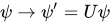 , where
  is 3 × 3 unitary matrix with determinant 1, making it a member of the group SU(3), and
  is an arbitrary function of spacetime.
 where the subscript
  sums over the three generations of fermions;
  , and
, and  are the left-handed doublet, right-handed singlet up type, and right handed singlet down type quark fields; and
  and
and  are the left-handed doublet and right-handed singlet lepton fields.
 , where
  (
( ) and
) and  are the
  do not respect
 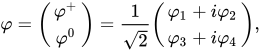 where the superscripts + and 0 indicate the electric charge
  of the components. The weak hypercharge
  of both components is 1. Before symmetry breaking, the Higgs Lagrangian is
 where
where  is the electroweak gauge covariant derivative defined above and
  is the potential of the Higgs field. The square of the covariant derivative leads to three and four point interactions between the electroweak gauge fields
  and
and  and the scalar field
  . The scalar potential is given by
 where
where  , so that
  , so that the potential is bounded from below. The quartic term describes self-interactions of the scalar field
  . It is possible to perform a
  and
and 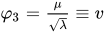 . This breaks the symmetry of the ground state. The expectation value of
 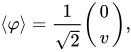 where
where  has units of mass and sets the scale of electroweak physics. This is the only dimensional parameter of the Standard Model and has a measured value of ~
 and
and 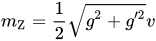 , which can be viewed as predictions of the theory. The photon remains massless. The mass of the
 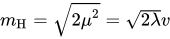 . Since
  and
and  are free parameters, the Higgs's mass could not be predicted beforehand and had to be determined experimentally.
 where
where  ,
,  , and
, and  are
are  and
and  and
and  is its charge conjugate state.
